On 17–18 October 2026, the Second Academic Symposium on Mount Kailash Cultural Studies, convened by Professor Jiang Jingkui, Dean of the Institute for International and Area Studies (IIAS) at Tsinghua University, was held at Tsinghua University. The symposium was jointly organised by the Centre for South Asian and Southeast Asian Studies at IIAS and the Centre for Indian Studies of the Department of Foreign Languages and Literatures at Tsinghua University. It brought together nearly 80 participants from more than 30 research institutions and publishing organisations in China and abroad, including Tsinghua University, Peking University, the Chinese Academy of Social Sciences, Renmin University of China, Minzu University of China, the National University of Defense Technology, Sichuan University, Tibet University, the Tibet Academy of Social Sciences, Xizang Minzu University, Northwest University, Southwest Minzu University, the Yunnan Academy of Social Sciences, the National Museum of Ethnology of China, the National University of Singapore, The Commercial Press and the Encyclopedia of China Publishing House. Drawing on interdisciplinary perspectives from area studies, religious studies, history, linguistics, archaeology, ethnology, geography, communication studies, political science and international relations, participating scholars engaged in dialogue around the distinctive concept of “Mount Kailash Culture”, proposed by Professor Jiang Jingkui. They explored its unique place in the historical development of the Chinese national community and in exchanges among the world’s diverse civilisations, providing substantial academic and theoretical support for strengthening the sense of community among the Chinese nation and developing China’s independent knowledge and discourse systems.
At the opening ceremony on the morning of 17 October, Professor Jiang Jingkui extended a warm welcome and sincere thanks to all the experts and scholars attending the symposium. In his subsequent keynote address, Professor Jiang offered a detailed examination of “Mount Kailash Culture” and its essential significance through a research approach he termed “deconstructing, correcting and establishing”. His systematic analysis sought to dispel erroneous views concerning Tibet and the sacred mountain constructed by British and Indian colonialists and their successors, correct misconceptions among relevant domestic audiences, explore the cultural attributes of Mount Kailash as part of Chinese civilisation, and advance the development of an independent Chinese knowledge system grounded in “Mount Kailash Culture”. The opening ceremony was chaired by Associate Professor Jia Yan, who holds a tenured position at IIAS.
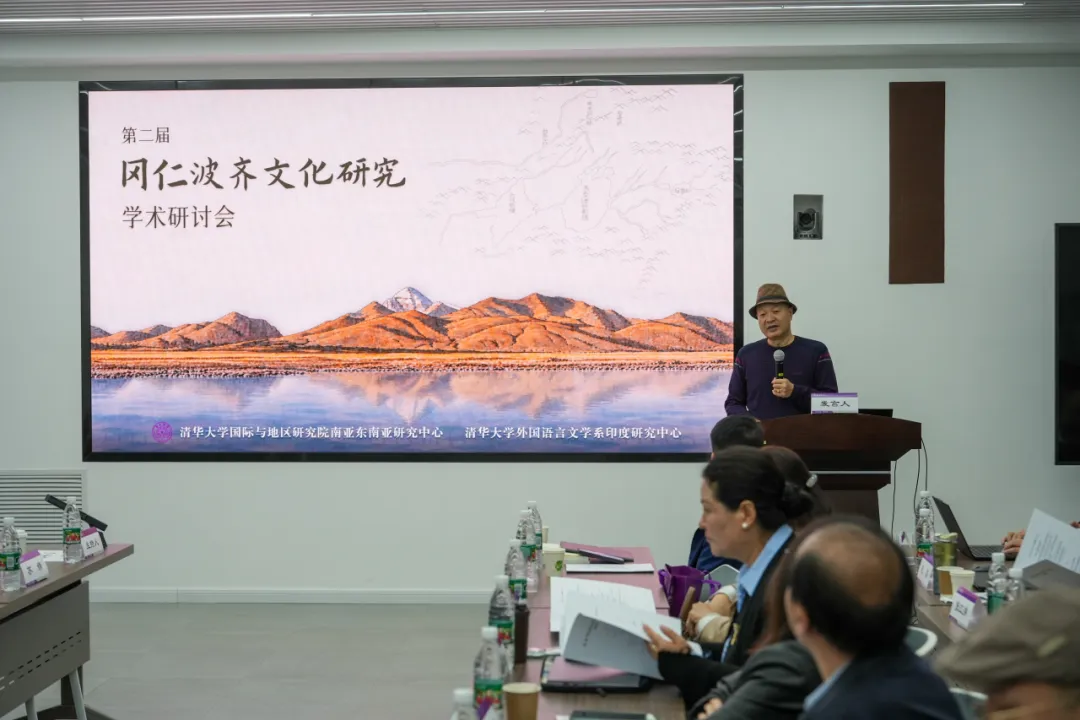 Professor Jiang Jingkui delivering the opening address and keynote speech
Following the opening ceremony, participating scholars held productive discussions across five themes: “Historical Heritage and Cultural Significance”, “Historical Geography and Spatial Perceptions”, “Cross-Regional Connections and Exchanges”, “Geopolitics and Colonial Constructions”, and “Language, Culture and Narrative Dissemination”.
The first session, themed “Historical Heritage and Cultural Significance”, was chaired by Professor Liao Bo of the School of Foreign Languages at the National University of Defense Technology. Professor Tsering Tashi of the School of Chinese Ethnic Minority Languages and Literatures at Minzu University of China took the annual Horse Year pilgrimage around Mount Kailash as his starting point, examining the historical integration of the horse image into the Bon tradition of sacred mountain worship and the horse’s significance as an important symbol within indigenous belief systems on the Qinghai–Tibet Plateau. Research Fellow Zhang Changhong of the Institute of Chinese Tibetan Studies at Sichuan University drew on cave remains dating from the eleventh to fifteenth centuries in the Ngari region as his primary historical evidence to examine the interaction between local political power and religious activities during this period, offering rich archaeological evidence for reconstructing the traditional relationship between political and religious authority in Ngari. Research Fellow Mu Shihua of the Institute of Ethnology and Anthropology at the Chinese Academy of Social Sciences conducted a graphic and textual examination of mountain deity symbols in Naxi Dongba script. He argued that their visual prototypes were intrinsically connected to Mount Kailash, revealing the diverse ways in which representations of sacred mountains have been expressed and transmitted across different ethnic cultures. Professor Xu Jun of the College of History and Culture and the Institute of Chinese Tibetan Studies at Sichuan University focused on India’s construction of narratives surrounding its bid to have “Kailash” inscribed on the World Heritage List. He analysed how folk legends from different ethnic groups have been incorporated into the discourse of India’s national sacred mountain, and how Indian religious nationalism has selectively reshaped and hierarchically reorganised layered traditions of diverse beliefs. Danzhen Yangjin, a curator at the National Museum of Ethnology of China, took the Qing-dynasty work Imperially Commissioned Gazetteer of the Western Regions as her principal source, examining official records of Mount Kailash’s geographical location and related cultural traditions during the Qianlong reign and explaining the historical process through which the Gangdise Mountains were incorporated into the official geographical knowledge system of the Qing dynasty.
The second session, themed “Historical Geography and Spatial Perceptions”, was chaired by Associate Professor Su Jing, who holds joint appointments in the School of Journalism and Communication and the School of Humanities at Tsinghua University. Tong Mei, a professor at the Centre for Bon Culture Studies in Tibet, Southwest Minzu University, drew on golden masks and associated artefacts unearthed in the Ngari region. She pointed out that the cultural significance embodied in these remains bears strong similarities to that of artefacts excavated at Sanxingdui, offering new leads for cross-regional cultural comparison. Professor Deng Hui of the College of Urban and Environmental Sciences at Peking University examined the historical relationship between Mount Kailash, the Kunlun Mountains and the source of the Yellow River from the perspective of ancient Chinese conceptions of Tianxia (All Under Heaven). He focused on how geographical understandings of the Kunlun Mountains and the river source gradually extended towards and were integrated into the Qinghai–Tibet Plateau across different historical periods. Yan Xianghai of the School of the Chinese National Community at Xizang Minzu University traced changes in perceptions of the relationship between the Kunlun Mountains and Mount Kailash during the Qing dynasty, exploring the profound influence of the development of Qing geographical knowledge on the spatial identification of sacred mountains. Associate Professor Xie Zhibin of the School of Area Studies and the Centre for South Asian Studies at Northwest University examined the formation and dissemination of the Buddhist concept of sacred mountains. He discussed how, during the process of the localisation of Buddhism in China, pre-existing local beliefs in sacred sites were transformed through religious interpretation and acquired new sacred meanings. Assistant Research Fellow Yang Zhiguo of the School of Humanities at Tsinghua University used GIS technology to digitally reconstruct and analyse the Xifan map series in the Complete Map of the Imperial Territories, exploring how official Qing maps represented the topography and spatial configuration of the Qinghai–Tibet Plateau and the characteristics of the geographical knowledge they conveyed. Wang Haorui, a doctoral student in the Department of Foreign Languages and Literatures at Tsinghua University, compared relevant Bon and Hindu texts to clarify the historical origins and sacred meanings behind the different names “Gangdise”, “Mount Kailash” and “Kailash”, distinguishing the historical connections and differences in perception among various systems of sacred mountain belief.
The third session, themed “Cross-Regional Connections and Exchanges”, was chaired by Associate Professor Xie Zhibin of Northwest University. Professor Liao Bo of the National University of Defense Technology examined historical military encounters between the Tibetan Empire and South Asia, analysing in depth the historical context of the Tibetan Empire’s southward expansion and its impact on early interactions between China and India. Professor Wang Guisheng of the Collaborative Innovation Centre for the Development of China's Ethnic Minority Economies at Tibet University traced the historical development of society in the Mount Kailash region, examining the processes through which diverse local cultural traditions came into contact, interacted and converged, and explaining the historical foundations and internal dynamics behind the formation of Mount Kailash Culture. Associate Professor Su Jing of Tsinghua University focused on the ancient Tubo–Nepal route during the early Tang dynasty, examining the formation, evolution and historical continuity of this transport corridor connecting the Tibetan Empire and Nepal. Zhou Wenqiang, a member of the Lhasa–Ngari Xiangxiong Culture Academic Symposium, drew on documentary accounts and oral histories of Indian pilgrims travelling to Tibet to reconstruct and introduce their journeys to the Mount Kailash region and their cultural perceptions along the way. Associate Professor Yan Yuanyuan of the School of Foreign Languages at the National University of Defense Technology focused on the Yadong Valley, tracing the historical development of this important passage along the China–India border and its role in cross-border transport and exchanges. Remao Youli, a doctoral student at the School of Philosophy and Religious Studies at Minzu University of China, approached the subject through the translation of Sanskrit and Tibetan texts. By comparing the specific geographical areas referred to by terms such as “Great Snow Mountain”, “Kailash” and the “Gangdise Mountains”, she explored the historical reasons why different concepts of sacred mountains were regarded as corresponding to one another, and at times conflated, in the process of textual translation.
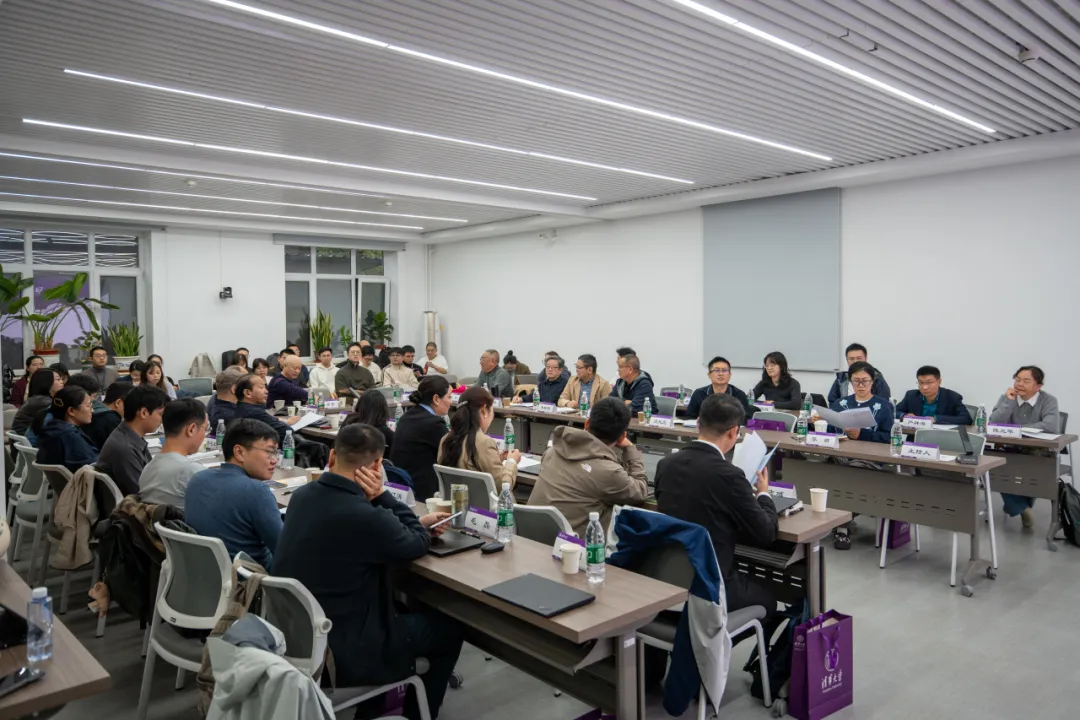 The symposium in progress
On the morning of 18 October, the fourth session, themed “Geopolitics and Colonial Constructions”, was chaired by Associate Professor Yan Yuanyuan of the National University of Defense Technology. Research Fellow Li Li of the Editorial Office of South Asian and Southeast Asian Studies at the Yunnan Academy of Social Sciences analysed how overseas exile forces use cultural issues to interfere with the governance of China’s Tibetan-inhabited regions, and offered academic reflections on possible targeted responses. Assistant Research Fellow Zhang Jianghong of the Institute of South Asian Studies at the Tibet Academy of Social Sciences took the activities of Swami Pranavananda as his central focus, tracing the explorations of the Mount Kailash–Lake Manasarovar region undertaken by Indian monks during the period of British and Indian colonial rule, as well as the formation of related colonial narratives. Associate Professor Wang Zhaodong of the School of International Studies at Renmin University of China examined India’s construction of sacred-site narratives surrounding Mount Kailash since independence, focusing on how India has used religious narratives to assign specific cultural meanings to the mountain and the relationship between this process and the construction of modern Indian national identity. Yang Zezhou, a postdoctoral researcher at the Asia Research Institute of the National University of Singapore, systematically reviewed the history of attempts by modern Western visitors to climb Mount Kailash, examining how this “unclimbed mountain” entered the field of Western exploration and geographical investigation and became an object of colonial knowledge production. Hao Siyao, a postdoctoral researcher at the Institute of Modern History of the Chinese Academy of Social Sciences, approached the subject through the commercial expansion of Britain in South Asia in modern times, tracing the history of illegal surveying and mapping of the Mount Kailash–Lake Manasarovar region by the East India Company and the British Indian government, driven by economic interests.
The fifth session, themed “Language, Culture and Narrative Dissemination”, was chaired by Research Fellow Li Li of the Yunnan Academy of Social Sciences. Professor Jiumaocuo of the Centre for Nepal and Bhutan Studies at Tibet University examined Tibetan communities in Nepal, distinguishing between the circumstances and characteristics of different groups and offering policy reflections on how to carry out more targeted, differentiated cultural communication. Associate Professor Mao Lei of the School of Foreign Languages at the National University of Defense Technology drew on the history of linguistic exchanges along the Silk Road to discuss the role of multilingual systems as bridges for communication and links of identity in cross-regional cultural interactions. Associate Professor Chen Lihua of the Institute of Ethnology at Xizang Minzu University examined how Mount Kailash and Lake Manasarovar have been represented in contemporary media, analysing the mechanisms through which the dissemination of related cultural symbols shapes public perceptions. Lü Zhonglin of the School of Foreign Languages at the National University of Defense Technology traced the historical formation and spatial distribution of the diverse languages spoken in the Ngari region, analysed the current state of the local linguistic ecology, and explored the interaction between the protection of linguistic diversity and the modernisation of local governance.
At the conclusion of the symposium, Professor Jiang Jingkui delivered closing remarks. He noted that, compared with the inaugural Academic Symposium on Mount Kailash Cultural Studies held in November 2025, this year’s event was larger in scale and, while focusing more closely on the concept of “Mount Kailash Culture”, demonstrated an even stronger emphasis on multidisciplinary integration and interdisciplinary exploration. The successive convening of the two symposia marks an important transition in research on “Mount Kailash Culture”, from the introduction of the concept to the deepening of academic consensus. It has also established a central platform for substantive collaboration among scholars of different generations, from different regions and with diverse disciplinary backgrounds. Looking ahead, Professor Jiang called on scholars to continue their in-depth research in this field, further advance the discovery and collation of historical materials, and promote the examination and clarification of key historical questions. He emphasised the importance of producing more substantial and rigorous academic research to continually enrich the theoretical substance of “Mount Kailash Culture”, thereby contributing new scholarly strength to the development of China’s independent knowledge system and the strengthening of the sense of community among the Chinese nation.
We look forward to welcoming scholars from around the world back to Tsinghua University for the Third Academic Symposium on Mount Kailash Cultural Studies in 2027.
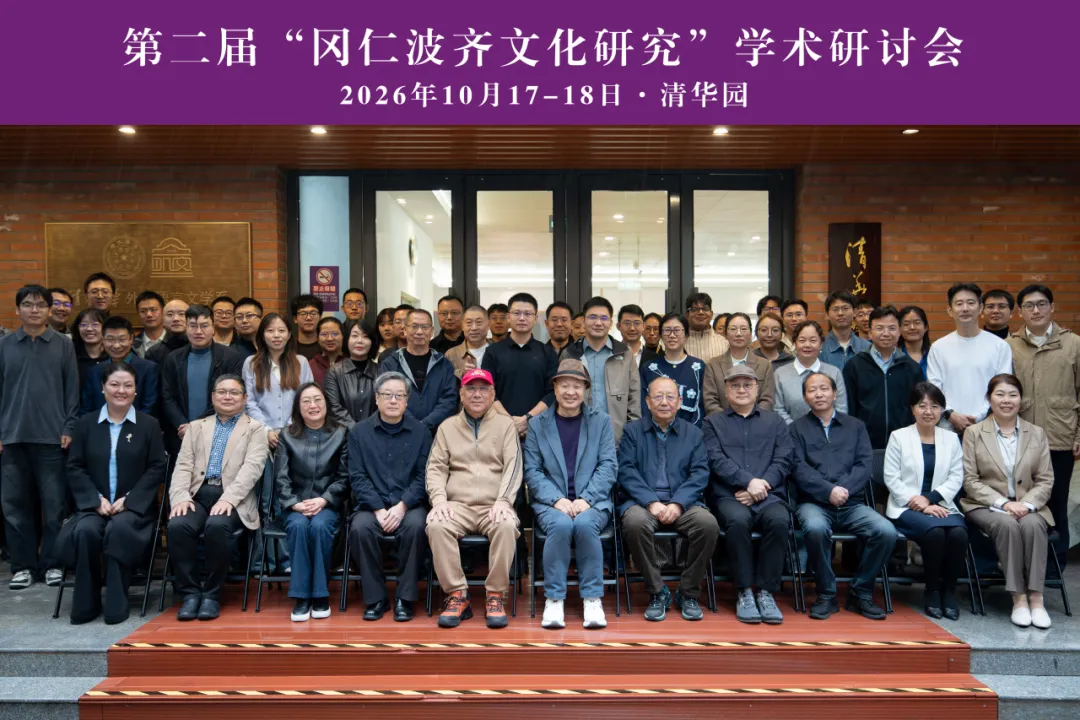 Group photo of symposium participants